Friday, January 10, 2020

Sarcos Robotics Guardian XO exoskeleton


LAS VEGAS — Delta Air Lines Inc. has partnered with Sarcos Robotics to demonstrate the Guardian XO industrial exoskeleton at CES 2020 here this week. The Guardian XO is a battery-powered, full-body exoskeleton designed to boost human performance and endurance while helping to prevent injury, said Sarcos.
This robotic suit does the heavy lifting for employees by bearing its own weight in addition to a payload. Guardian XO can enable a worker to lift up to 200 lb. repeatedly for up to eight hours at a time without strain or fatigue. Because the Guardian XO supports natural, fluid and intuitive movement, it requires relatively minimal operator training. A user can put on or take off the exoskeleton in just 30 seconds, said the company.

Delta explores exoskeletons

“We owe it to the best airline employees on the planet to explore how emerging technology can make their jobs safer and easier,” said Gareth Joyce, senior vice president for airport customer service and cargo at Delta. “That’s why we sought out a partnership with Sarcos.”
Delta said it is the first company whose front-line employees have worked directly with Sarcos to determine potential operational uses for the Guardian XO. In November, Delta personnel visited Sarcos’ headquarters in Salt Lake City, Utah, to see the exoskeleton in action and explore how wearable robotics could help them in their everyday work.
The Guardian XO is designed for use in industries where lifting and manipulation of heavy materials or awkward objects is required and isn’t easily handled by standard lift equipment. Potential uses at Delta could include handling freight at Delta Cargo warehouses, moving maintenance components at Delta TechOps, or lifting heavy machinery and parts for ground support equipment.
Exploring how advanced tools and tech can better support employees is one way Delta aims to improve workplace safety while extending its industry lead in operational performance for customers.
Delta plans to test the technology in a pilot location during the first quarter of 2020, giving employees the opportunity to experience the tech in a real-world setting and provide additional feedback on its functionality.

Sarcos Robotics’ Guardian XO exoskeleton will help ramp agents lift heavy loads. | Credit: Delta Airlines

Guardian XO could level the playing field

The robotic suit may also level the playing field in terms of physical capacity. Roles that have historically been limited to those who meet specific strength requirements could potentially be performed by a more diverse talent pool, thanks to wearable robotics.
“We look for companies who are clear leaders in tech adoption and have a history of innovating to meet the needs of their customers and their employees,” said Ben Wolff, CEO of Sarcos. “Delta is the natural fit in the airline industry and has proven to be a great partner as we work to fine-tune this technology for commercial deployment.”
Delta first started working with Sarcos in 2018 as part of its “X-TAG,” or exoskeleton technical advisory group, representing the aviation sector. This council includes ten of the Fortune 100 across a variety of industries, including industrial manufacturing, oil and gas, utilities, logistics, construction, automotive, aviation, and aerospace.
CES attendees can see Guardian XO for themselves at Delta’s booth, No. 14035, in Central Hall of the Las Vegas Convention Center. Sarcos is now accepting orders for the Guardian XO and will deliver commercial production units in late 2020.

Source: www.therobotreport.com

Friday, September 27, 2019

Atlas - The world’s most dynamic humanoid robot

Atlas is a research platform designed to push the limits of whole-body mobility. Atlas’s advanced control system and state-of-the-art hardware give the robot the power and balance to demonstrate human-level agility.

TECHNOLOGY


Efficient

Atlas has one of the world’s most compact mobile hydraulic systems. Custom motors, valves, and a compact hydraulic power unit enable Atlas to deliver high power to any of its 28 hydraulic joints for impressive feats of mobility.


Dynamic

Atlas’s advanced control system enables highly diverse and agile locomotion, while algorithms reason through complex dynamic interactions involving the whole body and environment to plan movements.


Lightweight

Atlas uses 3D printed parts to give it the strength-to-weight ratio necessary for leaps and somersaults.

Thursday, June 11, 2015

South Korea's DRC-HUBO Robot Won the DARPA Robotics Challenge


Photo: DARPA
This robot won the DARPA Robotics Challenge 2015.
On Saturday, Team KAIST from South Korea emerged as the winner of the DARPA Robotics Challenge (DRC) in Pomona, Calif., after its robot, an adaptable humanoid called DRC-HUBO, beat out 22 other robots from five different countries, winning the US $2 million grand prize. The robot’s “transformer” ability to switch back and forth from a walking biped to a wheeled machine proved key to its victory. Many robots lost their balance and collapsed to the ground while trying to perform tasks such as opening a door or operating a drill. Not DRC-HUBO. Its unique design allowed it to perform tasks faster and, perhaps more important, stay on its feet—and wheels.
“Bipedal walking [for robots] is not very stable yet,” Jun Ho Oh, a professor of mechanical engineering at the Korea Advanced Institute of Science and Technology who led the KAIST Team, told IEEE Spectrum. “One single thing goes wrong, the result is catastrophic.” He said a robot with a humanoid form has advantages when operating in a human environment, but he wanted to find a design that could minimize the risk of falls. “I thought about different things, and the simplest was wheels on the knees.”

DARPA decided to organize the DRC after the Fukushima accident in Japan, hoping to advance the field of disaster robotics. The DRC Finals called for teams of semi-autonomous robots and human operators to work together in a simulated disaster environment. The robots created by universities and companies for the competition varied widely in size and shape and include legged robots, wheeled robots, and hybrids as well.
DRC-HUBO prevailed over other robots because it completed all eight tasks flawlessly in the shortest amount of time (44 minutes and 28 seconds). Other teams also performed well in the competition, but setbacks made their robots lose time. These included Tartan Rescue’s CHIMP, a robot with legs and tank-like tracks that was the only robot to get back up after a fall; the University of Bonn’s Momaro, an elegantly simple wheeled machine with a spinning head and two arms; NASA Jet Propulsion Laboratory’s RoboSimian, a four-legged robot that seemed to perform yoga moves; IHMC’s ATLAS, a large hydraulic-electric humanoid made by Boston Dynamics (and used by other DRC teams).


“Flexibility is the most important thing,” DARPA program manager and DRC organizer Gill Pratt said at a media briefing, commenting on the different robot designs. A robot that could change its configuration from using legs to using wheels, he explained, might be heavier and more complex, but would “give you that flexibility.”
Professor Oh is an internationally recognized expert in humanoid robots. He and his students at KAIST in Daejeon, South Korea, have been improving their HUBO platform over several generations. Below is a video from a few years ago, when Professor Oh gave us a tour of his lab and a demonstration of HUBO 2.

For the DRC Finals, Professor Oh decided to make significant modifications to specifically address the tasks the robots would face. At a workshop after the competition, he said DRC-HUBO is “nothing very special, just a humanoid robot.” But in fact, his team at KAIST custom designed and built almost every part of the robot. He estimated the cost of each humanoid at between $500,000 and $1 million. Here are some of the key features that helped the robot win the competition:


  • Wheels on knees: DRC-HUBO has motorized wheels on both knees as well as casters on its feet [right]. The wheels let the robot move around in a fast and stable manner. When rolling on the ground, it uses optical sensors on the shins for optical flow odometry.
  • Powerful motors: Like SCHAFT, the robot that won a preliminary DARPA robot challenge and was acquired by Google, DRC-HUBO draws a lot of power from its motors (there are 33 in the robot, which has 31 degrees of freedom). With customized motor drivers and an air cooling system (fans and fins), the robot is able to drive 3x to 4x more current than what is listed in the motor specs, with peaks of 30 amperes in some cases.
  • Compliance: The team wanted to make their robot compliant, but didn’t want to use force-torque sensors and a conventional feedback controller (which they feared would introduce instabilities). So instead the implemented compliance on their custom motor driver, using a special amplifier.
  • Rotating torso: DRC-HUBO can turn its upper body up to 180 degrees. That means that the robot can have its knees pointing one way and its eyes looking at the opposite direction (you try that!). This capability works both in standing mode and kneeling mode, and the robot relied on it during several tasks, including driving the vehicle, cutting the wall [right], pushing away rubble, and climbing stairs.
  • Long arms: The KAIST Team realized that the arms of HUBO 2 were too short for some tasks, so they designed longer 7-degrees-of-freedom arms for DRC-HUBO, and they also tucked all cables inside, to prevent them from getting caught on things. Each arm can hold up to 15 kilograms, and has an “adaptive gripper” capable of grasping hard or soft objects.
  • Simplified sensing: Instead of a sensor-packed head with stereo cameras and a lidar that is continuously scanning the environment (used in the ATLAS robots, for example), DRC-HUBO uses a simplified vision system; operators rely on a regular camera most of the time, and a lidar, attached to a servo, scans the environment only when needed. In fact, the robot appears to have no head, “only eyes,” one KAIST student told us.
  • Robust power: When motors draw lots of current, the main power system may fail to provide enough power to critical components. To avoid that, the team used a supercapacitor system that keeps computers, communications, and some sensors like gyros running even if the main power system goes down.

  • Custom software: The team uses the Xenomai real-time operating system for Linux and a customized motion control framework called PODO developed at KAIST. They also use the Gazebo simulation environment. The team designed their software with a focus on the low bandwidth and unstable nature of communications between operators and robot.

  • Now let’s take a closer look at DRC-HUBO going through all eight tasks in the run that gave Team KAIST its victory (if you want to watch the full run back-to-back, we uploaded it here; the full run at 20x is here):

    1. Drive Task: Teams were allowed to make certain modifications to the Polaris vehicle so their robots could drive it and get out of it more easily. Team KAIST placed a metal contraption with two levers on the floor of the vehicle; when DRC-HUBO pressed one of the levers, a cable system made the second lever press the accelerator. The robot holds on to the vehicle with its left hand and steers with its right one. It completes this task very, very fast (in a little over a minute) and, unlike other teams, it doesn’t stop while going around the barriers.


    2. Egress Task: This was one of the most difficult tasks in the competition. When planning for it, Professor Oh said he got in and out of the vehicle himself several times, to see what kind of motions and parts of his body he needed to use. He concluded that a “dynamic approach” was needed. His team programmed DRC-HUBO to put its arms up and hold on to the frame of the vehicle. Then the robot applies 100 newtons of pulling force to each arm. As the arms pull the robot’s body up, it pretty much falls out of the vehicle, albeit in a controlled manner (hence the “dynamic approach”). Pay attention starting at 1:00. It’s a beautiful egress maneuver! Professor Oh said the team burned several motors perfecting this motion, but solved the problem using their high power custom motor drivers. In the actual run, the robot is able to get out in less than 4 minutes, and once it’s off the vehicle, it gets on its knees and zips away.


    3. Door Task: Unlike several other robots that had to stand (and balance on two legs) to perform this task, DRC-HUBO could stay on its knees to manipulate the door knob. It elegantly uses its other arm to hold the door open while it releases the knob. In less than 2 minutes, it’s going through the doorway on its knee-wheels.


    4. Valve Task: Note at the beginning of the video how the lidar moves up and down to give the operators a scan of the scene ahead. Then, as DRC-HUBO approaches the valve, it performs a 180-degree upper body rotation. Pay attention at 0:20 or you’ll miss it (the camera angle doesn’t show the lower part of the robot, unfortunately). In this configuration, while still kneeling, the robot can raise its body just enough so that it can better manipulate the valve (why stand if you don’t have to?). The robot performs some more lidar scans, adjusts its position, and in about 3 minutes it’s done with the task. Note that only one full turn was required but DRC-HUBO performs two complete turns! At 2:01 you can see the robot “undoing” the torso rotation.


    5. Wall Task: This was a tricky task for most teams because it required a precise grasp of a drill, and the robots had to press a trigger or on/off button to use the tool. DRC-HUBO relied on a force-torque sensor on each hand to help with grasping. You can see the robot moving itself and even repositioning the drill on the shelf (even knocking down another drill out of the way) to find a good way to grab it. Once the robot has the tool, operators indicate where to cut and the robot does the rest autonomously. It keeps 20 newtons of force against the wall, and you can see how it uses its whole body to move the drill in a perfect circle. Completing this task takes about 11 minutes.


    6. Surprise Task: The surprise task consisted of pulling out a plug and putting it back into another socket. Note how DRC-HUBO scans the floor and notices that the drill it had knocked down earlier is on its path. The robot turns around and pushes the tool away with its knees. It then tries to turn around but looks like it hits the wall. The operators apparently notice the problem and drive forward a bit and then are able to turn. Finally they approach the wall with the plug, which is positioned higher than the valve and door knob. It’s time to get up on its feet, and you can watch that happening starting at 3:05. DRC-HUBO takes some steps forward and after a while it initiates the grasping process. It grabs the plug by its cable; we believe that was intentional, to allow the operators to better see the plug and prevent the robot’s hand from obstructing their view, which would make the task nearly impossible. Inserting the plug proves tricky, and at 7:47 you can see how the robot tries to push it in and misses the socket. After some corrective motions, success! The task takes 13 minutes and 30 seconds, the slowest in the run.


    7. Rubble Task: While kneeling, DRC-HUBO can drive with its knees pointing forward, or it can turn its upper body 180 degrees and drive with its feet pointing forward and acting as a bulldozer’s blade. And that’s what it does for this task. You can see the torso rotation starting at 0:28. It’s so cool. The robot then puts its arms up, probably for stability and preventing them from getting caught in the debris. It then starts plowing through the rubble. It stops momentarily when it appears that a piece of wood might get stuck on the cinder blocks, so it turns left a bit to get that out of the way. It then moves the plastic tube to the right. At 4:14 it rotates its torso once again and positions itself in front of the stairs. The task took less than 5 minutes.


    8. Stairs Task: Professor Oh said that, for many tasks, especially climbing stairs, it’s important that the robot is able to see its own feet. Big robots like ATLAS have a hard time doing that, having to bend their bodies and making balancing more difficult. DRC-HUBO solves this problem in a very clever way. It climbs the stairs backwards! By doing that, its knees don’t block the robot’s cameras from seeing its feet and the ground, and another advantage is that its shins won’t ever hit the steps when it bends its legs. But how does it see its own feet if it’s climbing the stairs backwards? By rotating its upper body, of course! You can see the process starting at 0:26. The robot is kneeling in front of the stairs when it suddenly turns its back to it. It then stands up and at 0:55 you can see it turning the torso 180 degrees. Now it can scan the stairs and start the climb. But note that, before doing that, it takes two steps sideways, to the left (1:45)! After a couple of minutes—which felt like an eternity for those watching—the robot finally starts going up, climbing the final three steps in a continuous maneuver. Neat! After less than 7 minutes, DRC-HUBO is atop the platform. The video has no audio, but at this point the team and audience had exploded in cheers.


    KAIST built four DRC-HUBOs and had been practicing without safety cables for over a month prior to the event. They did their runs outdoors, on a parking lot with rough ground and under a variety of conditions, including heavy sunlight and strong winds. “If we don’t remove safety, operators are too fearful,” Professor Oh said at the post-competition workshop.
    He added that, during practice, they completed all tasks with the robot both in walking and kneeling modes (their average time was about 30 minutes). The team was particularly good at clearing debris with DRC-HUBO’s arms, something they didn’t get a chance to demonstrate at the DRC Finals, and they could also comfortably perform the tasks on much more difficult terrain than the one at the competition.
    “Pity that we could not present that kind of beautiful walking at the challenge. . . . It was too easy!” Professor Oh said, walking off stage to applause.
    Team KAIST at DARPA Robotics Challenge

    Source: http://spectrum.ieee.org

    Monday, March 16, 2015

    ReWalk Exoskeleton

    The ReWalk™ robotic exoskeleton will make a guest appearance in Yaskawa’s booth. A ReWalker will demonstrate how the device provides powered hip and knee motion, enabling individuals with spinal cord injuries to stand upright and walk.

    Robotic exoskeleton helps individuals with spinal cord injuries to walk (Courtesy of ReWalk Robotics, Inc.)According to ReWalk Robotics, the device’s manufacturer, the ReWalk Personal is the only powered exoskeleton with U.S. Food and Drug Administration clearance. A rehabilitation version is also FDA approved.

    In September 2013, Yaskawa announced its investment in Argo Medical Technologies, now ReWalk Robotics. DeRosett says there are parallels between exoskeletons and where production robots could be going in the near future.

    “I think technology is moving in that direction, providing exoskeletons that can assist people in manufacturing or production environments to lift and move payloads that are not ergonomically practical today,” he says. “That could also translate into warehousing, supply chain and distribution environments.”

    In fact, a recent report is projecting more than 70 percent growth for exoskeletons in the medical, military and industrial markets through 2019.

    “Our core is all about motion and control,” says DeRosett, referring to Yaskawa’s expertise in servo motors and controllers. “That’s really much of the technology that’s needed in these types of devices.”

    “There’s been a lot of discussion around collaborative robots, and humans and robots working together,” adds DeRosett. “You can’t get anymore collaborative than an exoskeleton.”

    Robotic exoskeletons, especially those expected to populate factory floors and warehouses, blur the distinctions between industrial, collaborative and service robots, a rapidly emerging phenomenon we explored in RIA’s latest forecast article, Robotics 2015 and Beyond: Collaboration, Connectivity, Convergence.


    Source: http://www.robotics.org/content-detail.cfm/Industrial-Robotics-Industry-Insights/One-and-Only-Automation-Showcase-for-Robotics-Vision-and-Motion-Control/content_id/5251

    Sunday, December 8, 2013

    The commercial drone race


    Desperately need a textbook? This Australian drone is coming to this rescue!via PandoDaily

    That Amazon is readying a fleet of drones to drop off packages to customers seems like yet another example of the company’s cutting edge. The project could go live as early as 2015, after the US approves laws for commercial use of unmanned aerial vehicles (UAVs), but a slew of companies around the world are already leaps ahead of Amazon.

    Australian startup Flirtey is in the unmanned aerial-vehicle business, and it's partnered with a company called Zookal to effectively create the Amazon.com of textbooks that delivers by way of drone instead of UPS.
    flirtey


    Australian authorities were among the first in the world to deem commercial-drone usage legal, so Flirtey got to work finding ways to apply the technology. By partnering with textbook company Zookal, Flirtey will use its drones to deliver Zookal customers' orders directly to them.
    It previously cost Zookal an average $8.60 in shipping costs to fill an order. Now that drones will be handling delivery, however, that average shipping cost drops to an estimated $0.80 per order.
    Here's how TechCrunch's Catherine Shu described it:
    "Zookal will use Flirtey to send parcels for free and claims deliveries can be made in as little as two or three minutes, compared to two or three days for traditional shipping methods. Upon arrival at an outdoor delivery destination, Flirtey’s drones hover and lower the parcel through a custom delivery mechanism that is attached to a retractable cord. Real-time GPS tracking of each drone’s location will be available through the Flirtey app for smartphones."
    Intrigued? Check out this video with the founders to learn more.

    While the Australian flight authority still has to approve Zookal’s plans, commercial drones are allowed to fly within 122 meters (400 feet) of the ground.


    Australia’s looser regulations could help make it a commercial drone pioneer. ”As one of the few countries in the world to allow commercial drone activities, Australia is uniquely placed to create a new drone industry and shape the development of regulations in this space,” Zookal CEO Ahmed Haider told The Verge. The company’s joint-venture partner, a startup called Vimbra, is now signing up other businesses for drone deliveries, reports PandoDaily.


    Breathing down Zookal’s neck is Shunfeng Express, one of China’s biggest parcel delivery services, which began testing drone delivery back in September. The city police where SF Express is testing its drones, which can fly as high as 100 meters, are so far permitting the drone flights. According to Chinese media reports, SF Express insiders say the company has successfully completed drone testing (links in Chinese).


    with-package
    Read more: 

    Saturday, July 27, 2013

    Venipuncture robot

    Please hold still: Veebot’s robot system can find a vein and place a needle at least as well as a human can. Clinical trials are expected to begin this year.
    You probably know the routine for drawing blood. A medical technician briefly wraps your arm in a tourniquet and looks your veins over, sometimes tapping gently with a gloved finger on your inner elbow. Then the med tech selects a target. Usually, but not always, she gets a decent vein on the first try; sometimes it takes a second (or third) stick. This procedure is fine for the typical blood test at a doctor’s office, but for contract researchers it represents a significant logistics problem. In drug trials it’s not unusual to have to draw blood from dozens of people every hour or so throughout a day. These tests can add up to more than a hundred thousand blood draws a year for just one contract research company.

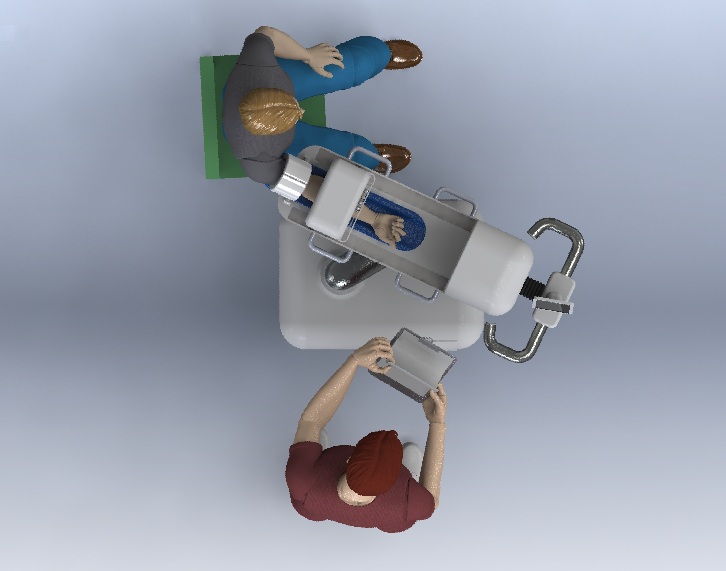
    Veebot, a start-up in Mountain View, Calif., is hoping to automate drawing blood and inserting IVs by combining robotics with image-analysis software. To use the Veebot system, a patient puts his or her arm through an archway over a padded table. Inside the archway, an inflatable cuff tightens around the arm, holding it in place and restricting blood flow to make the veins easier to see. An infrared light illuminates the inner elbow for a camera; software matches the camera’s view against a model of vein anatomy and selects a likely vein. The vein is examined with ultrasound to confirm that it’s large enough and has sufficient blood flowing through it. The robot then aligns the needle and sticks it in. The whole process takes about a minute, and the only thing the technician has to do is attach the appropriate test tube or IV bag.
    Veebot began in 2009 when Richard Harris, a third-year undergraduate in Princeton’s mechanical engineering department, was trying to come up with a topic for a project. At the same time, his father, Stuart Harris, founder of a company that does pharmaceutical contract research, mentioned that he’d love to see someone come up with a way to automate blood draws.
    Harris says he was drawn to the idea because “it involved robotics and computer vision, both fields I was interested in, and it had demanding requirements because you’d be fully automating something that is different every time and deals with humans.”
    He built a prototype that could find and puncture dots drawn on flexible plastic tubing, and with funding from his father, he cofounded Veebot in 2010.
    Currently, Veebot’s machine can correctly identify the best vein to target about 83 percent of the time, says Harris, which is about as good as a human. Harris wants to get that rate up to 90 percent before clinical trials. However, while he expects to achieve this in three to five months, he will then have to secure outside funding to cover the expense of those trials.
    Harris estimates the market for his technology to be about US $9 billion, noting that “blood is drawn a billion times a year in the U.S. alone; IVs are started 250 million times.” Veebot will initially try to sell to large medical facilities.
    Thomas Gunderson, managing director and a senior analyst at investment bank Piper Jaffray Companies, believes the time is right for this kind of medical device company. In a difficult case, “doctors today will search all over the hospital for the right person to do a blood draw, and they could still miss three or four times,” he says. “Technology can help from a labor standpoint and make the procedure safer for the patient and for the person drawing the blood.”
    The biggest challenge, Harris says, is human psychology. “If people don’t want a robot drawing their blood, then nobody is going to use it. We believe if this machine works better, faster, and cheaper than a person, people will want to use it.”
    Says Gunderson: “These days we have multimillion-dollar robots doing surgery. I think we passed ‘creepy’ several years ago and moved on.”
    Sources:
    http://www.veebot.com
    http://spectrum.ieee.org

    Thursday, May 9, 2013

    Eidos sensory augmentation

    Fans of "Iron Man," take notice: A group of students at the Royal College of Art in London have created two masks that can give you superhuman sight and hearing.
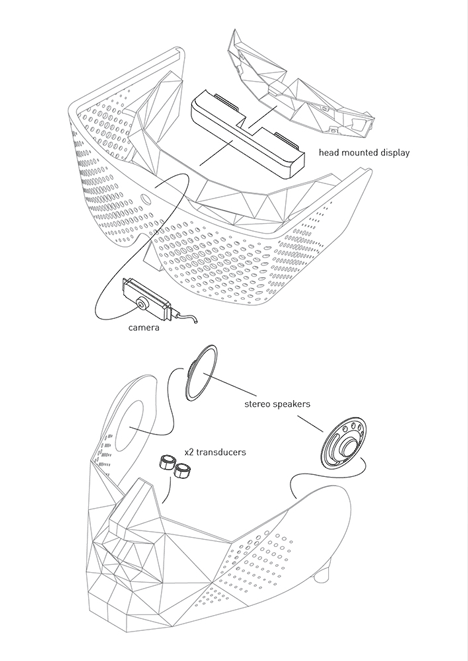
    The first prototype covers the wearer's ears, mouth and nose and uses a directional microphone to give him the ability to hear an isolated sound in a noisy environment. For example, you could target a person in a crowd and clearly hear his words without the surrounding noise.
    The other prototype is worn over one's eyes. A camera captures video and sends it to a computer, which can apply a set of effects to it in real-time and send it back to the wearer. One can, for example, use it to see movement patterns, similar to the effects of long-exposure photography.

    The team behind project Eidos — Tim Bouckley, Millie Clive-Smith, Mi Eun Kim and Yuta Sugawara — see many possible applications of this technology. For example, one could use the visual mask it to analyze movement and technique in sports. In another example, concert-goers could use the hearing mask to focus on a certain performer at a concert.

    We are used to controlling the world around us, to find the settings that suit us best. What if we had the same control over our senses? If we could adjust them in real time, what new experiences could this make possible?

    Eidos consists of two pieces of experimental equipment that give you superhuman sight and hearing. Eidos Vision enhances the way we see motion, while Eidos Audio lets us hear speech more selectively.

    Eidos has broad application in areas where live audio and video analysis is valuable. For example, sportspeople can visualise and improve technique in real time. Eidos also has healthcare benefits where it can be used to boost or refine sensory signals weakened by ageing or disability. In the arts, Eidos can augment live performance such as ballet, fashion or music concerts. It allows us to highlight previously invisible or inaudible details, opening up new and customisable experiences.

    with:
    Millie Clive-Smith
    Mi Eun Kim
    Yuta Sugawara


    Please be advised that stock footage and the references in the video are used for inspirational purposes and to explain our project only. They are not our own work and we do not own the rights to them.

    See Eidos featured on:
    Dezeen
    FastCo Design
    CNN
    Wired.com
    Discovery News
    Mashable
    The Verge