Fans of "Iron Man," take notice: A group of students at the Royal
College of Art in London have created two masks that can give you
superhuman sight and hearing.
The first prototype
covers the wearer's ears, mouth and nose and uses a directional
microphone to give him the ability to hear an isolated sound in a noisy
environment. For example, you could target a person in a crowd and
clearly hear his words without the surrounding noise.
The other prototype is
worn over one's eyes. A camera captures video and sends it to a
computer, which can apply a set of effects to it in real-time and send
it back to the wearer. One can, for example, use it to see movement
patterns, similar to the effects of long-exposure photography.
The team behind project Eidos
— Tim Bouckley, Millie Clive-Smith, Mi Eun Kim and Yuta Sugawara — see
many possible applications of this technology. For example, one could
use the visual mask it to analyze movement and technique in sports. In
another example, concert-goers could use the hearing mask to focus on a
certain performer at a concert.
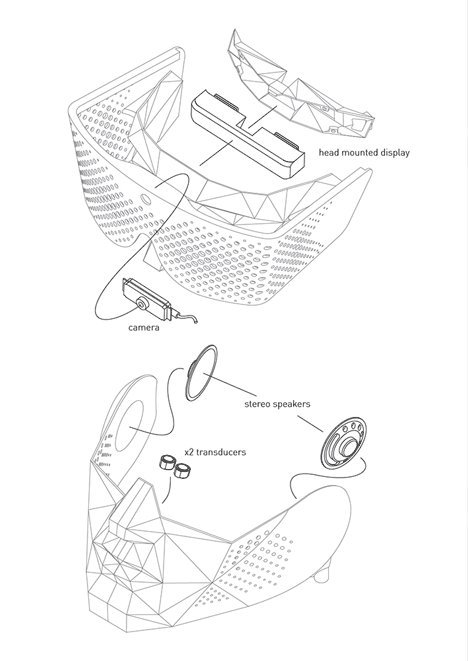 Eidos consists of two pieces of experimental equipment that give you
superhuman sight and hearing. Eidos Vision enhances the way we see
motion, while Eidos Audio lets us hear speech more selectively.
Eidos consists of two pieces of experimental equipment that give you
superhuman sight and hearing. Eidos Vision enhances the way we see
motion, while Eidos Audio lets us hear speech more selectively.Eidos has broad application in areas where live audio and video analysis is valuable. For example, sportspeople can visualise and improve technique in real time. Eidos also has healthcare benefits where it can be used to boost or refine sensory signals weakened by ageing or disability. In the arts, Eidos can augment live performance such as ballet, fashion or music concerts. It allows us to highlight previously invisible or inaudible details, opening up new and customisable experiences.
with:
Millie Clive-Smith
Mi Eun Kim
Yuta Sugawara
Please be advised that stock footage and the references in the video are used for inspirational purposes and to explain our project only. They are not our own work and we do not own the rights to them.
See Eidos featured on:
Dezeen
FastCo Design
CNN
Wired.com
Discovery News
Mashable
The Verge

No comments:
Post a Comment